Monday, 1 February 2016


Fizzy Ice

Exploring science is an exciting and wondrous part of early childhood. To carry out their scientific “wonderings,” children need time to explore and discover scientific concepts in risk-free, playlike settings. It is through these repeated experiences involving interaction with people and materials—the physical and social environments—that children construct their own knowledge (Piaget, 1952; DeVries & Kohlberg, 1990). When children are interacting with materials, observing, questioning, thinking, making predictions, and experimenting to confirm their ideas in a meaningful setting, they are making maximum use of the brain’s capacity for learning (Bredekamp & Rosegrant, 1993).

The following activity during one of our Young Explorer Sessions provided the perfect opportunity for our young visitors to explore and investigate properties of ice.  The language captured by our facilitator provides a glimpse into the rich learning that was taking place that morning.

For one of our Young Explorers programs this January we chose to explore ice….Fizzy Ice at that!
Here are the supplies we needed:
• 2 Large bags of ice in a big container
• Vinegar.
• Water Colour.
• Pipettes
• Baking Soda.

After the supplies were gathered, we were ready to begin!
We began by shaking baking soda over the large pieces of ice. This made the ice look like an arctic world.
Whoa…that smells yukky [vinegar].”

Look, Chelsey….Its fizzing!”
The children began to drop different colours on the ice and were amazed by the reaction that was made when the vinegar reacted with the baking soda. They were also amazed by the mixing of colours and how the liquid dripped in-between each ice cube. As the ice began to melt it encouraged a lot of conversation about lakes, waterfalls and rivers.
I can hear the bubbles…they make a fizzy pop!”
- “Look, it’s dripping, it’s like a water fall!”

See, the colours mixing Mom, it is purple!! Its melting….it looks like a big lake!”     “It’s a big rainbow on the ice!”

Submitted by Lynda Gellner B.ED, M.ED
Pictures and Documentation provided by Chelsey Hobman


Monday, 18 January 2016

Choices 

In our child-centred environments, providing children with choices is something you will see everyday.  Providing choices is not only beneficial for developing a child's self-esteem but also for cognitive development.  A child's self-esteem grows when they successfully do things for themselves and of course it doesn't stop in childhood.  I reflect on the many times that I have had an increased sense of accomplishment when tackling a new experience on my own.   Making choices is also a building block of problem solving.  When children are given choices, they stretch their thinking and create new and unique combinations of ideas and materials.

"Would you like to use Red or Blue?” Myriam  asks. It is important to have a choice. It is especially important for Miss C to have a choice because she is two. Why is it so important for a two year old to choose ? It is not particularly important whether she selects red or blue but what is important is that she is given a real choice. 


 Myriam knows that it is important for young children to make choices in their life so that they will feel some sense of control, which contributes to healthy personality development by building up a sense of autonomy.
Children had the choice of using the salad spinner to explore spinning and paint or to use an electronic turntable.


This facilitator realizes that by giving children  authentic, limited choices, she is building their confidence. Myriam is also eliminating much of the negativity often associated with two year olds . Children feel in control by making choices like what colours they will use or the type of spinner they will use. That growing sense of control reduces the child’s need to try to gain control in negative ways. But those choices must be authentic.


Thank you to our facilitator Myriam for sharing this invitation with children with the children visiting the Early Years Family Centre and for sharing the photos with me.


Lynda Gellner B.Ed; M.Ed


Monday, 11 January 2016

Loose Parts

If you have been to our Early Years Family Centre you have most likely seen a number of "loose parts" available for our visitors to interact with.  We are often asked why do we include them in our space.

Loose parts are materials that can be moved, carried, combined, redesigned, lined up and taken apart and put back together in multiple ways.  They are materials that have no specific direction and can be used alone or in combination with other materials.

 We love the fact that by playing with loose parts children are using more creativity and imagination and of course working on fine motor skills as they manipulate the materials.


Notice the variety of loose parts provided in this kitchen area - the types of meals prepared are not limited by the materials provided


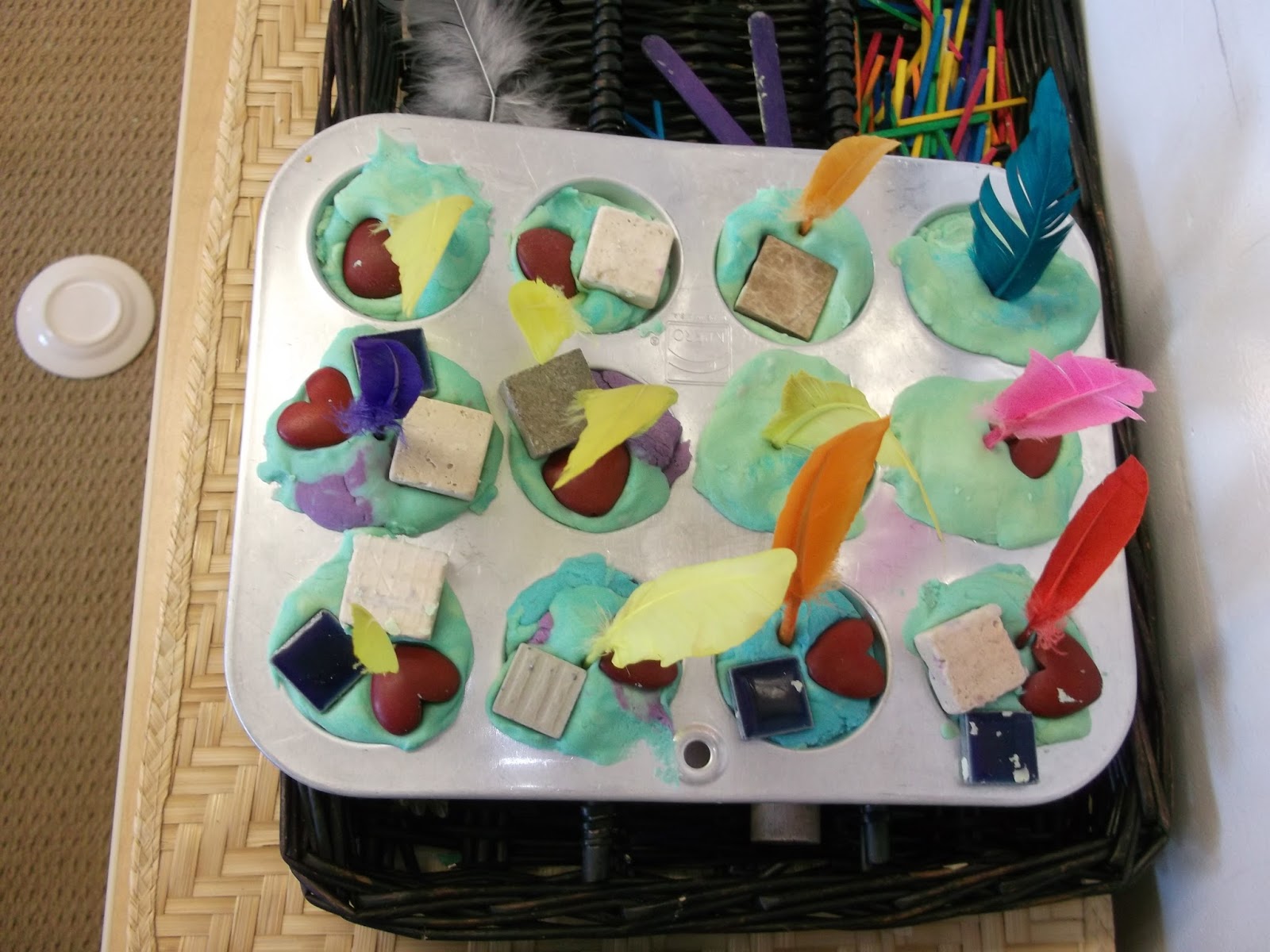
Loose Parts available with play-doh provides endless possibilities.


Here is a great example of how one of our young friends utilized rocks, sticks and animals.

Looking for more information - check out this blog on Let the Children Play

Great Resource - Loose Parts by Daly and Beloglovsky
Posted by Lynda Gellner  B.Ed., M.Ed.
Early Years Family Centre Developer  


Sunday, 22 November 2015

Salt Art


On a piece of paper glue salt in a desired design. 
Next, use food colours/water colours and a pipette to colour the salt.  


Puffy Paint


How to make puffy paint:

Equal parts of Elmer's glue and shaving cream
Add a few drops of food colouring/water colour
Mix and Voila 
Have fun creating and painting


Tim Hortons Smile Cookie Campaign


A very special thank you to the Regina and Area Tim Horton's owners and teams as well as all the customers that supported the Smile Cookie Campaign. Today the EYFC was presented with a cheque for $55,300. We are blessed to have such incredible community support!

Wednesday, 4 November 2015

House Rules

Every house needs a few house rules to operate well. Please respect and follow our "house" rules for everyone's safety and enjoyment of the program.

  • Make sure you sign in
  • Treat all people and things with respect and care
  • Parents/caregivers are responsible for supervision of their children
  • We need your help to maintain a clean environment
    • No snacks in the centre please (tables available outside of the space)
    • Clean up after yourself
    • Use the changing tables provided in the washroom
  • Please remove all outdoor shoes and boots. Indoor shoes may be brought with you and used in the play and learn space and program room.
  • Cell phones are not permitted during scheduled programs
For health reasons and the safety of others, we ask:

  • If your child has a runny nose, fever, diarrhea, vomiting or other communicable diseases, please avoid coming to the centres until fully recovered. 
  • Leave personal toys at home
  • Please do not let your child walk around the centre with their bottle 
  • Please put mouthed/dirty toys in the "toys to be cleaned" box 
  • Please do not bring peanuts or nut products to the centres 


Thank You for Your Support

Wednesday, 28 October 2015

Pumpkin Exploration

This fall at Scott we have had many different invitations set up for the children to explore. 

One of the many has been pumpkins.

First, we cut open all the pumpkins and emptied them out.   Once empty we put all the pumpkin seeds, etc. into a clear ziploc bag.  The children were then able to get a close look at what is inside a pumpkin.


Next we painted a few of the pumpkins and tried out an activity called "drip-painting." The activity uses acrylic paint so it is important to wear old clothes or a paint shirt to avoid stains.  The children were given a squeeze bottle of the paint .  They started at at the top of the pumpkin and squeezed out some paint and watched as it dripped down the sides of the pumpkin.  This can be continued with as many colours as desired around the entire pumpkin. 


Lastly, we tried pumpkin-cano’s. The pumpkin was placed in the bottom of the water table for an easy clean up. (Note: a tray or large dish would work as well.) The children then poured enough baking soda into the pumpkin to just cover the bottom of the pumpkin.  They added a few drops of dish soap (optional) and then poured vinegar into the pumpkin and watched the "science" happen! The children loved the erupting pumpkin-cano’s so much we repeated it several times each taking turns dumping and pouring different measurements of the ingredients into the pumpkin. 


Doing Science experiments with children help to develop math skills while they measure and experiment with different measurements.  They begin to develop critical thinking by seeing what happens if they change what ingredient is added first, etc. (For example: adding the vinegar before the baking soda, etc). Pouring and dumping the various ingredients also develops both fine and gross motor skills. 

As winter is quickly approaching be sure to come to our locations to see what new changes are happening. Also be sure to check out the November calendar to stay updated. 

Laura Bieber

Together we make a family

This fall at Scott we made family trees. Laura had the tree trunks already painted and the families wrote the names of their family members on real oak tree leaves.  They then glued the leaves on top of the tree trunks.  The finished trees were hung and displayed for all to see.    


The family trees reinforced the idea that there are many people who can support us with whatever we may need help within our daily lives. They also showed those who may visit daily, weekly, monthly or just once in awhile the friendship, diversity and support they will encounter at the Centre.  

We greatly appreciate all "our" families who come in and make our programs successful. We would not be doing the work we do without you!

Thank you for your continued support!

Laura Bieber

Tuesday, 27 October 2015

Creating Marbleized Paper


Our facilitator provided children with an opportunity to explore colour mixing but with a twist. 

Children were provided with three containers that contained vegetable oil, food colouring and a little bit of water. They were then invited to add drops of colour onto a black tray and to swirl the colours together.  Mixing on the black tray meant that you couldn’t really see how the colours were mixing until you pressed the blank sheet against the surface and then pulled it away to see your masterpiece. 


The children (and adults) were delighted to turn over their papers to discover how their colours had mixed and the patterns that were created.  One young friend stayed at this activity for over 30 minutes and experimented with different strategies and techniques.


 “Children use their senses, their minds and their bodies to find out about and make sense of what they see, feel and experience in the world around them. They gather information and develop new skills, including thinking skills. They form ideas and theories and test these out. They refine their ideas through exploring their environment actively and through interacting and communicating with adults and with other children. Much of this happens through play and    other experiences that allow children to be creative, to take risks, and to make discoveries. As they learn, they retest their theories adjusting them to take on board new discoveries and new experience”  National Council for Curriculum and Evaluation


Lynda Gellner 

Monday, 12 October 2015

Collaborative Art


Art is an important part to a child's development. Through art they learn to create and manipulate materials in a way that expresses their ideas in a different form than play does.

Collaborative art is a form of art that allows children the opportunity to work together as a team. This team building activity opens children up to sharing their different life and cultural experiences. By sharing these experiences children see and learn that everyone has similarities and differences and that everyone's contributions should be accepted equally.

By working as a team, incorporating all shared ideas in some way and accepting each other for who they are is evident in the completed collaborative art product.

Laura Bieber


Thursday, 8 October 2015

Country Fair


Yes it is true! Laura's Country Fair is traveling to a Centre near you!

Come on out to enjoy some old time fun. There will be games such as: a fishing pond, ring toss, sack races, etc. plus a photo booth, ball pit, snacks and a pie eating contest that will be at 10:45 am!

Miller's Country Fair- Thursday October 22 (10 a.m. to 12 p.m.)
Dr. Hanna's Country Fair- Saturday October 24 (10 a.m. to 12 p.m.)
 
Hope to see you there for a good ol' time!
 

Laura Bieber


Sunday, 4 October 2015

Magic Milk


This week we had some fun experimenting with science and art.

What you need:
Milk
Larger tray/dish
Food colouring
Dish soap
Q-tips

Pour a little bit of milk into your dish (enough to cover the bottom). Next create a design with the food colouring in the milk (we covered all the milk). Lastly dip a q-tip into the dish soap and stick it into the middle of the tray. Watch the magic happen!


Experiment and explore as long as you want. 

After we were done we pressed a piece of paper into the tray to create a “water colour like” painting. 


Children of all ages were amazed with this neat science/art experiment. Guaranteed hours of fun. 

Laura Bieber